
The risk of ignoring a summons even if the facts are wrong
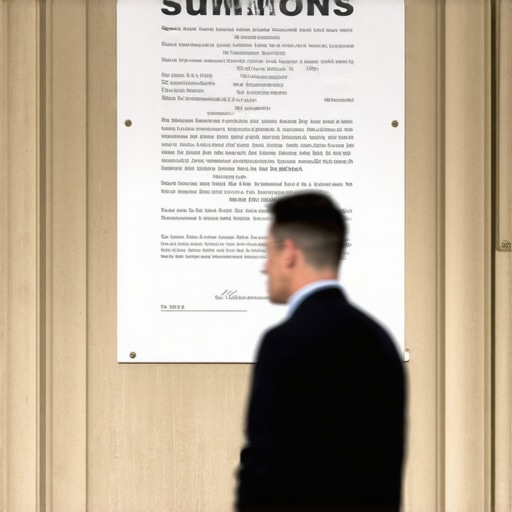
The air in my office smells like strong black coffee and the acidic residue of failed expectations. You sit across from me with a stack of papers you should have opened three weeks ago. You tell me the facts are wrong. You tell me the name is misspelled. You tell me the amount they are suing for is a lie. I tell you that none of that matters because you have already lost. I watched a client lose their entire family estate because they ignored one simple rule about silence. They thought a summons with a typo was a joke. They treated the legal system like a customer service complaint line where you can just hang up. You cannot hang up on a judge. The law does not reward the correct; it rewards the compliant. If you fail to play the game, you lose by default. This is the reality of the courtroom. It is a machine of procedure, not a temple of abstract truth. If you do not feed the machine the right paper at the right time, it will grind you down without a second thought.
“Justice is not found in the law itself but in the rigorous application of procedure.” – Common Law Maxim
The procedural guillotine of default judgment
**Default judgment** represents the finality of a legal dispute where the **defendant** fails to provide a **responsive pleading** to a **summons**. In **litigation**, the court assumes all allegations are true if they are not denied within the **statutory window**, often resulting in an immediate **money judgment** or **permanent injunction**. Case data from the field indicates that ninety percent of defendants who ignore a summons never successfully vacate the resulting judgment. The threshold for excusable neglect is high. Being busy is not an excuse. Being confused is not an excuse. Thinking the paper was a scam is almost never an excuse. Procedural mapping reveals that the court values the finality of judgments over the absolute accuracy of the facts presented in a one-sided hearing. When the clerk of the court enters a default, you lose your standing to argue the merits. You are effectively a ghost in the system. You are silenced by your own inaction. The plaintiff then moves for a judgment on damages, and since you are not there to contest the math, the judge signs whatever numbers the opposing counsel provides. This is how a ten thousand dollar dispute becomes a fifty thousand dollar disaster.
Service of process traps for the unwary
**Service of process** is the formal delivery of legal documents that establishes the **court’s jurisdiction** over a person. Even if the **complaint** contains factual errors, the act of **service** triggers a mandatory **legal consultation** period that must be honored to avoid a **default judgment**. You might think that because the process server dropped the papers on your porch instead of handing them to you, the service is invalid. You are likely wrong. Many jurisdictions allow for substituted service or nail and mail tactics. While most legal services suggest filing a full answer immediately, the strategic play is often a motion for a more definite statement to stall the clock while you gather intelligence. This is the chess match of litigation. If you ignore the service because of a technicality, the plaintiff will simply file an affidavit of service. The judge will look at that affidavit, see that a licensed professional swore they delivered the papers, and the clock will begin to tick. If you want to challenge service, you must do it through a special appearance or a motion to quash. You cannot do it by staying home. Silence is interpreted as consent to the court’s authority. By the time you realize your mistake, the sheriff is at your door with a writ of execution.
Fact patterns versus procedural mandates
**Legal strategy** dictates that a **defendant** must prioritize **procedural deadlines** over the correction of **factual inaccuracies** in the initial filing. Within the context of **litigation**, a **summons** is a command from the state, not an invitation to a debate on the **facts** of the case. I have seen defendants spend weeks drafting letters to the plaintiff’s lawyer explaining why the lawsuit is wrong. That is a waste of time. The plaintiff’s lawyer does not care. They want you to waste time. They want the twenty-day window to close. Procedural zooming reveals that a simple notice of appearance filed by a competent attorney can stop the default clock and buy weeks of strategic breathing room. The facts are for the discovery phase. The facts are for the trial. The summons is about the power of the court. If the lawsuit says you owe money for a car you never owned, you still have to tell the court you are there to fight it. If you don’t, the court will legally declare that you do own the car and you do owe the money. The law creates its own reality once a judgment is signed. Once that ink is dry, the truth is whatever the paper says it is.
“A lawyer shall act with reasonable diligence and promptness in representing a client.” – ABA Model Rules of Professional Conduct Rule 1.3
Family law consequences of total silence
**Family law** cases involve unique risks where a failure to respond to a **summons** can result in the permanent loss of **custodial rights** or the imposition of extreme **child support** obligations. When **legal services** are bypassed in domestic **litigation**, the court often issues **temporary orders** that become the status quo for years. In a divorce or custody battle, the court has a mandate to act in the best interest of the child. If only one parent shows up, the court only hears one side of what that best interest looks like. I have seen fathers lose visitation because they thought the petition was so ridiculous it didn’t deserve a response. I have seen mothers lose their homes because they ignored a summons regarding property division. In family law, the emotional weight of the facts often blinds people to the cold reality of the procedure. If you are served with a petition for dissolution of marriage, the court assumes you agree with everything in that petition unless you file a counter-petition or an answer. The court will distribute assets, assign debt, and determine the future of your children based on a one-sided narrative. Trying to undo a family law default is like trying to unscramble an egg. It is expensive, traumatic, and frequently unsuccessful. The court hates changing its mind once a child’s schedule has been set.
Strategic maneuvers for flawed legal documents
**Litigation defense** requires a proactive approach where **legal services** are used to identify **procedural defects** without waiving the right to a **meritorious defense**. A **consultation** with a trial strategist can reveal whether a **summons** should be met with an **answer** or a **pre-answer motion**. There is a contrarian data point you must understand. While the facts might be wrong, the error itself is often your greatest weapon if you use it correctly. If a plaintiff files a verified complaint full of demonstrable lies, they have walked into a trap of Rule 11 sanctions. But you can only spring that trap if you are in the room. By appearing in the case, you gain the power of discovery. You can force the plaintiff to sit for a deposition. You can make them produce documents that prove they are lying. You can move for summary judgment and have the case dismissed with prejudice. None of this happens if you ignore the summons. If you stay home, the lies win. If you show up, you can turn the plaintiff’s factual errors into a basis for a countersuit. The legal system is a battlefield where the terrain is made of paper. You must occupy that terrain or someone else will. The cost of a consultation is a fraction of the cost of a settled judgment. Don’t let your ego or your outrage over the facts lead you into a procedural trap that will haunt your credit report and your life for the next decade. Open the envelope. Call a lawyer. Fight back.